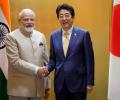
With the signing of the pact, the Quad grouping of India, Japan, Australia and the US is set to gain more heft now, notes Dr Rajaram Panda.

'The India-France relationship has been that of the elites of two countries, who appreciate each other's philosophical traditions -- whether it is ancient Indian civilisation and Sanskrit texts or the French tradition of Rene Descartes, Albert Camus, (Jean-Paul) Sartre... This is a drawback. It doesn't create the buzz, the excitement necessary for a relationship. We need more people-to-people contact, especially among students,' says former Ambassador to Paris, Rakesh Sood.

'China knows the best way of twisting the knife in its dealings with India: By launching a major incursion into Indian territory,' says Rajeev Sharma.

'We use the word "historic" perhaps too much, but the prime minister's visit certainly was historic in so many ways.'

Through the past 18-month period, peace has prevailed in the disputed border regions, which was immensely helpful in the difficult situation that the country was passing through, observes Ambassador M K Bhadrakumar.

Xi will attend the second informal meeting with Modi at Mahabalipuram near Chennai from October 11 to 12 and pay a state visit to Nepal on October 13, Foreign Ministry spokesperson Hua Chunying announced on Wednesday.
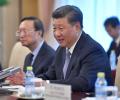
Xi said China is ready to work with Pakistan to forge a closer China-Pakistan community of shared future in the new era.
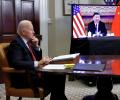
The highly-anticipated summit, which began early Tuesday, is the third engagement between Xi, 68, and Biden, 78, since February.
The US is working with India for developing three smart cities --Visakhapatnam, Ajmer and Allahabad
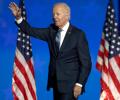
'The hardliners in Delhi are in for a big disappointment,' predicts Ambassador M K Bhadrakumar.

The tour is aimed at boosting India's economic engagement with these nations and inviting more investment.

Had India agreed to join the trade pact, Indian markets would have been flooded with cheap Chinese products.

'It is very significant that the president and the prime minister discussed Pakistan's efforts to take action against Lashkar-e-Tayiba and its affiliates.' 'This is something new and it demonstrates a recognition of Pakistan of the threats these terrorist groups pose to Pakistan and pose to other countries.'

Modi will have a number of high-profile multilateral and bilateral meetings with global leaders including United States Vice President Mike Pence and Singapore premier Lee Hsein Loong.
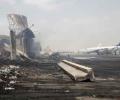
The United States on Wednesday warned that Pakistan faces a "serious" threat from the Taliban and offered its assistance to fight against terrorism after the recent attacks in Karachi.
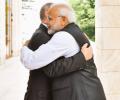
Modi said India and Russia have been friends for a long time and thanked Putin for inviting him for the first-ever informal meeting at Sochi.

'War cannot resolve problems. So wisdom is to resolve diplomatically.'

His view will be shaped by his perception of US world interests and India's economic performance relative to China.

'The Modi government's greatest blunder is to exploit sensitive external relations in its domestic politics,' says Shekhar Gupta.

This is the time when the US would need the conceptual strategic thinking of a Henry Kissinger, able to ally diplomatic skills with a well-conceived worldview of what the emergence of a new balance of forces will mean for a US whose ability to shape global events has definitely declined but still exists, says Claude Smadja.
The MEA said it was the Chinese side that recently undertakook activities hindering India's normal patrols in the areas.
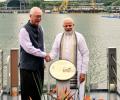
A beautiful rendition of 'Vaishnav Jan To Tene Kahiye', a favourite bhajan of Mahatma Gandhi, was sung on the occasion.

"This will be the first dinner for a foreign dignitary at the White House under this administration. So, we think that's very significant," a senior administration official told reporters at the White House on the eve of Modi's arrival.

Secretary Tillerson met with Foreign Secretary Jaishankar on Friday to discuss the US-India relationship and the agenda for Prime Minister Modi's meetings at the White House on June 26, a State Department spokesman said told PTI.
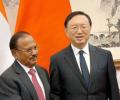
National Security Advisor Ajit Doval and his Chinese counterpart Yang Jiechi will meet in Hyderabad in November first week for informal dialogue on the state of bilateral relations

This is the joint statement issued by the ministry of external affairs on the visit of US President Barack Obama to India.

'One must remember that a dragon has a forked tongue,' warns Vivek Gumaste.

With Donald Trump the appeal has to be to his business instincts in which his personal interests seem to play a significant role, says former foreign secretary Kanwal Sibal.
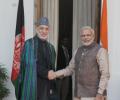
Security will be a consideration, as would protocol, but given Modi's penchant for the unconventional, it should not come as a surprise if he indeed decides to attend the ceremony in Kabul, says Ramesh Ramachandran.

'With the recent challenging of the notion of the Indian Ocean Region being India's strategic backyard, China is gradually upping the ante in the maritime realm around India.'

Modi held comprehensive talks with Singapore Prime Minister Lee Hsien Loong on ways to enhance cooperation in key sectors including trade and investment.

In an article published in the Sunday Telegraph as she left for India for her first bilateral visit outside the UK, she said plans to promote the best of Britain during her three-day trade mission to New Delhi and Bengaluru.

'The public has unfair expectations from Mrs Swaraj who is in Islamabad primarily for the Heart of Asia Conference. To restore India's position among stakeholders on Afghanistan is a fair one but to expect her to do more on the Indo-Pak front without requisite preparatory work is unrealistic.'
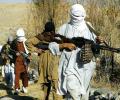
Pakistan National Security Advisor Sartaj Aziz brings to New Delhi a newfound Pakistani confidence, stemming from its leverage in Afghanistan, says Ajai Shukla

The United States welcomes India as a rising power and backs its inclusion as a permanent member of a reformed and expanded United Nations Security Council, Secretary of State John Kerry has said ahead of his maiden visit to New Delhi.

Cos ask US treasury to discuss data localisation norms with Indian officials at all platforms the two countries would meet, including G-20, US-India Strategic Dialogue, and IMF Annual Meet.
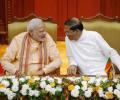
'What we have heard from the Sri Lankans is their desire to have a foreign policy that allows Sri Lanka to best advance its own interests rather than a foreign policy that relied solely on one relationship.' 'We think this is an attitude that makes a lot of sense. India and Sri Lanka have many areas of shared interests, and it's certainly welcomed by us to see that deepening of those ties.'

In an angry reaction to US Defence Secretary Ashton Carter's remarks that "China's actions could erect a Great Wall of self-isolation" in the South China Sea, Chinese foreign ministry spokesperson Hua Chunying told media that "Carter's remarks reflected typical American style thinking and hegemony".

'New Delhi showed itself willing -- at least for a period -- to tolerate the risk of conflict and to withstand Beijing's implicit and explicit threats.' 'But it also continued to try to cut some kind of deal with China to reduce tensions.'
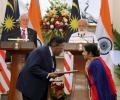
Considering the common linkages, high-level trust, complementarities, and convergent interests between the two nations, Malaysia has the potential to become India's key partner in Southeast Asia, says Dr Rahul Mishra.
